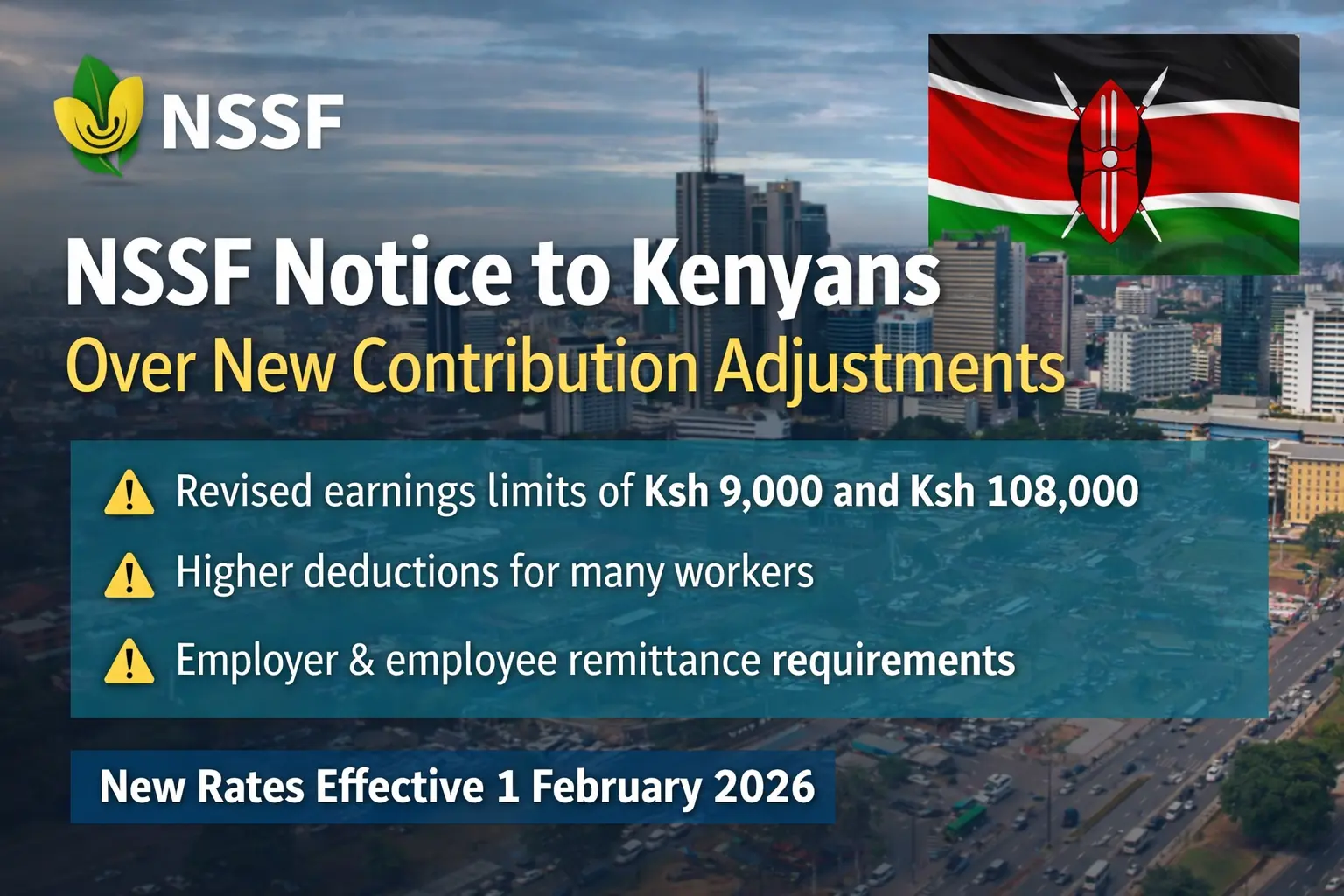
Starting 1 February 2026, the National Social Security Fund (NSSF) revised its earnings bands used to calculate mandatory pension contributions:
- Lower Earnings Limit (Tier I): KSh 9,000
- Upper Earnings Limit (Tier II): KSh 108,000
- Contribution rate remains 6 % for employees and 6 % for employers.
This means contributions are based on a percentage of your pensionable earnings within these two tiers: Tier I for basic coverage and Tier II for additional pension savings up to the new upper limit.
How This Affects Different Salary Brackets
1. Lower-Income Workers (Under ~KSh 50,000 Monthly)
- Impact: Minimal or no change to deductions.
- For workers earning below the Tier II threshold that existed before (previously around KSh 72,000), most of their pay was already within the pensionable range. With the new limits, their contributions stay similar.
- Example: Someone earning KSh 15,000 will contribute KSh 900 (6 % of 15,000) — the same as before — because all earnings fall within the valid contribution bands.
Take-home pay: Little change, so these workers won’t see a noticeable difference in their net salary due to NSSF changes.
2. Middle-Income Earners (Approximately ~KSh 50,000–100,000)
- Impact: Noticeable increase in pension contributions.
- For these workers, Tier I is fixed at KSh 540 (6 % of KSh 9,000), and Tier II contributions apply to earnings above that.
- Example: Someone earning KSh 100,000:
- Tier I: KSh 540
- Tier II: 6 % of KSh (100,000 – 9,000) = KSh 5,460
- Total monthly employee deduction: ~KSh 6,000
- Employer matches the same amount, making the total pension saving around KSh 12,000 per month.
Take-home pay: Such employees will see a clear reduction in net pay compared to previous years, because the expanded Tier II limit brings more of their salary into mandatory contributions.
3. High-Income Earners (Above ~KSh 108,000)
- Impact: Most significant increase in deductions.
- Once monthly salary exceeds the upper limit of KSh 108,000, contributions are capped at this top threshold.
- Example: Someone earning KSh 200,000+:
- Tier I: KSh 540
- Tier II: capped at 6 % of (108,000 – 9,000) = KSh 5,940
- Total employee deduction: KSh 6,480 per month
- With employer match: KSh 12,960 total per month.
Take-home pay: High-earning workers will see the largest reduction, losing more disposable income monthly, because a bigger portion of their salary is now subject to mandatory pension contributions.
Summary: Who Feels the Change Most?
| Salary Bracket | Impact on NSSF Contribution | Effect on Take-Home Pay |
|---|---|---|
| Low earners (<~KSh 50,000) | Little or no change | Minimal impact |
| Middle earners (~KSh 50k–100k) | Moderate increase | Noticeable reduction |
| High earners (>~KSh 108k) | Largest increase | Bigger monthly reduction |
Why the difference? The expanded Tier II upper limit (from KSh 72,000 to KSh 108,000) increases the base for contributions. That means more of a middle or high wage is now pensionable, so deductions go up even though the percentage rate stays the same.
What This Means for Employees
✔️ Stronger retirement savings: Over time, higher contributions mean a larger pension pot for future retirement.
✔️ Lower monthly take-home pay for many: Especially for those in the middle and higher pay brackets.
✔️ No sudden change for low-income workers: Current deductions remain largely unchanged.
Extra Notes
- Employers must update payroll systems to apply the new limits correctly and remit contributions by the required due date each month.
- Tier II contributions can, in some cases, be redirected to approved private pension schemes — but the minimum contributions still apply.