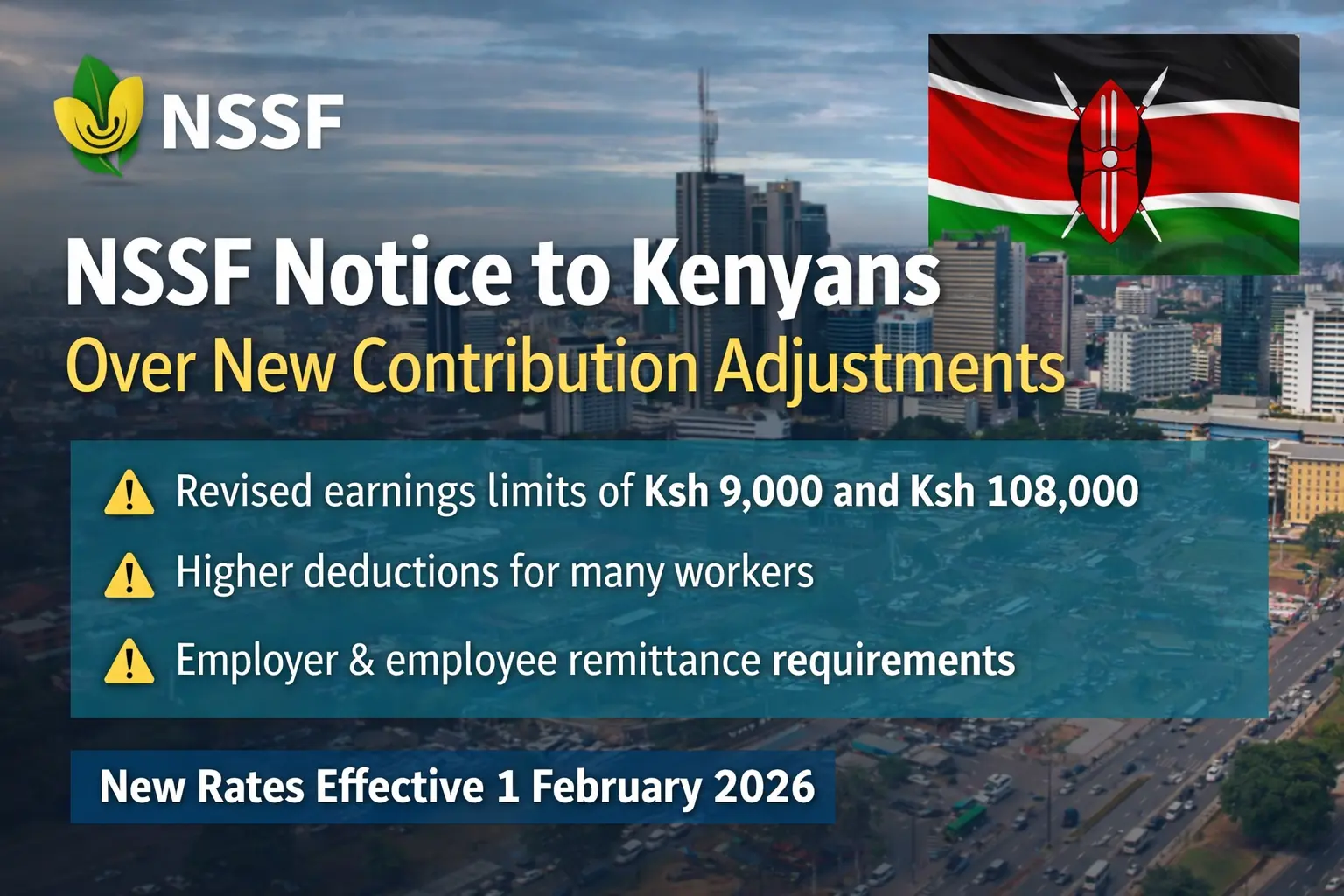
The National Social Security Fund (NSSF) has issued an official notice to employers and employees in Kenya about significant adjustments to contribution rates and limits, effective 1 February 2026. These changes, part of the final phase of implementing the phased reforms under the NSSF Act of 2013, will affect payroll deductions and take-home pay for many salaried workers and require employers to update their payroll systems accordingly.
What the New NSSF Contribution Adjustments Entail
Under the updated framework, the contribution rates remain at a combined 12 % of pensionable earnings, split equally between the employee (6 %) and employer (6 %). However, the income bands used to calculate these contributions have been significantly increased:
- Tier I (Lower Earnings Limit) rises to Ksh 9,000 per month (up from previously Ksh 8,000).
- Tier II (Upper Earnings Limit) increases to Ksh 108,000 per month (up from Ksh 72,000).
This means that for employees whose earnings fall within these new bands, the amounts deducted for NSSF will be higher than under the previous structure.
For example:
- On earnings up to Ksh 9,000 per month, both the employee and employer pay 6 % (Ksh 540 each), totalling Ksh 1,080.
- On salaries up to Ksh 108,000, both parties contribute Ksh 5,940 each, leading to a maximum combined contribution of Ksh 12,960 per employee per month.
Effective Date & Payroll Requirements
The new contribution limits and figures took effect on 1 February 2026. Employers have been instructed to adjust their payroll systems to reflect the revised thresholds and to submit remittances by the 9th day of the following month (starting in March 2026) to ensure compliance.
Employers may continue to channel Tier II contributions to approved private pension schemes if they choose, but the updated limits still apply when calculating deductions.
Impact on Employees’ Pay and Take-Home Income
The adjustments are expected to reduce take-home pay, particularly for middle- and higher-income earners, as a larger portion of their salaries becomes subject to mandatory pension contributions.
Payroll and tax experts note that while employees earning below approximately Ksh 50,000 may see minimal changes, those earning above Ksh 75,000 to Ksh 100,000 and higher will notice more significant reductions in net pay, as their contributions move into the expanded Tier II band.
Why the Changes Were Made
The adjustments are part of the multi-year implementation of the NSSF Act of 2013, aimed at strengthening retirement savings for workers in Kenya. The phasing in of higher earnings limits is intended to increase pension adequacy over time and expand the pension base for employees across the formal sector.
Experts argue that although the increases may tighten household budgets in the short term, especially amid high living costs, they could lead to higher long-term retirement benefits for contributors.
Reactions From Employers and Workers
The move has sparked discussions among employer groups and workers. Some employer organizations have expressed concern about the impact of higher deductions on take-home pay and business payroll costs, noting that workers already face multiple statutory deductions. Meanwhile, trade unions have defended the importance of robust pension contributions to ensure future financial security for workers.
Key Takeaways for Kenyans
- New NSSF limits took effect on 1 February 2026.
- The Lower Earnings Limit is now Ksh 9,000 and the Upper Earnings Limit is Ksh 108,000.
- Contributions remain at 6 % from both employer and employee, but the expanded income bands mean larger contributions overall.
- Employers must adjust payroll systems and remit payments on time.
- Many employees—especially those in higher income brackets—will see higher deductions from their payslips.
What You Should Do
For Employees:
- Review your payslips to understand how the new NSSF contributions are applied.
- Budget for the change in take-home pay, especially if your earnings fall in the higher brackets.
For Employers:
- Update payroll software to reflect the new Tier I and Tier II limits.
- Ensure NSSF remittances are submitted by the 9th of the following month to avoid compliance issues.